The client already ran on Oracle and wanted HR off spreadsheets without adding new infrastructure. We owned the full delivery on Oracle APEX: requirements, data model, screens, approvals, reports, and handover to their IT team.
The business
This HR management system was built on Oracle APEX for an enterprise client that needed employee records, payroll workflows, attendance, and approvals in a single, reliable system on top of their existing Oracle database.
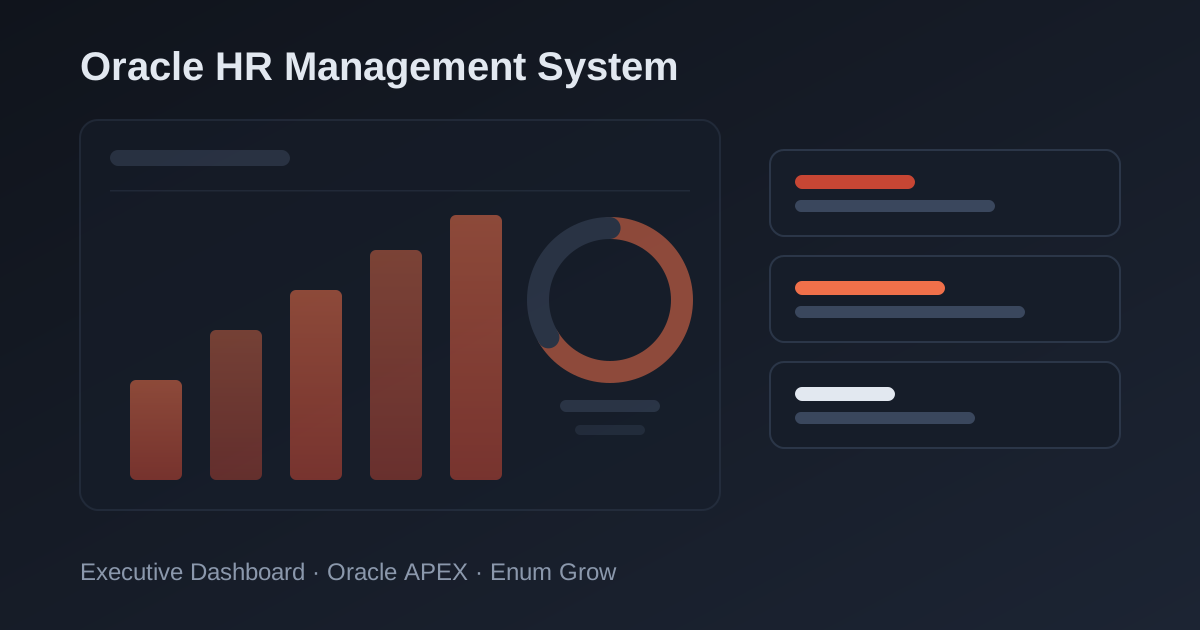
The executive dashboard gives leadership a live view of headcount, departmental KPIs, and payroll trends, replacing manual spreadsheet reporting with real-time analytics.
Role-based access keeps each employee, HR specialist, approver, and executive focused on the records and actions relevant to their responsibilities. Approval routing moves requests through the required reviewers, while HR reports can be filtered and exported for day-to-day work and management review.
The application uses Oracle Database and PL/SQL beneath the APEX interface, allowing it to work with the client's existing Oracle data and security model instead of creating a separate source for sensitive employee and payroll information.
Oracle APEX was the right delivery platform because the system stays inside the client's established Oracle stack. It provides the forms, workflows, dashboards, and reports HR needs without introducing separate application infrastructure for the client to operate.
How we delivered it
- 01
Discovery and scope
We met HR, finance, and IT separately. HR described the processes, finance described payroll rules, and IT set the security and hosting limits. We wrote these into one scope document the client signed off before development.
- 02
Design
We modelled employees, departments, contracts, and payroll in Oracle Database first, then designed the APEX pages around each role: employee, HR specialist, approver, and executive.
- 03
Development
Forms, approval routing, and payroll logic were built in PL/SQL and APEX in short iterations. HR reviewed each workflow in a test workspace before it moved on.
- 04
Testing
We tested every role against the permission matrix and ran payroll on sample months, comparing results line by line with the figures HR calculated manually.
- 05
Launch
We deployed into the client's existing Oracle environment, migrated employee records, and trained HR and approvers in short sessions on their real data.
- 06
After launch
IT received the data model, the PL/SQL packages, and a short admin guide, so they can maintain the system themselves. We stay available for new reports and workflows.
What made it work
Fits the client's stack
No new servers or vendors. The system lives inside the Oracle setup the client already trusts.
Security by role
Each user sees only the records and actions their job needs.
Handover the team can use
The client's IT owns the code and the documentation, not just a login.