Release with confidence, every time
Enum Grow provides manual and automated software testing for web and mobile products, from React and Next.js websites to React Native, iOS, and Android apps. We turn requirements and user journeys into a practical test plan, document repeatable test cases, verify fixes, and maintain regression coverage for future releases. The result is not a generic bug list. Your team receives clear evidence, severity, reproduction steps, expected behavior, and enough context to fix the right problems before customers find them.
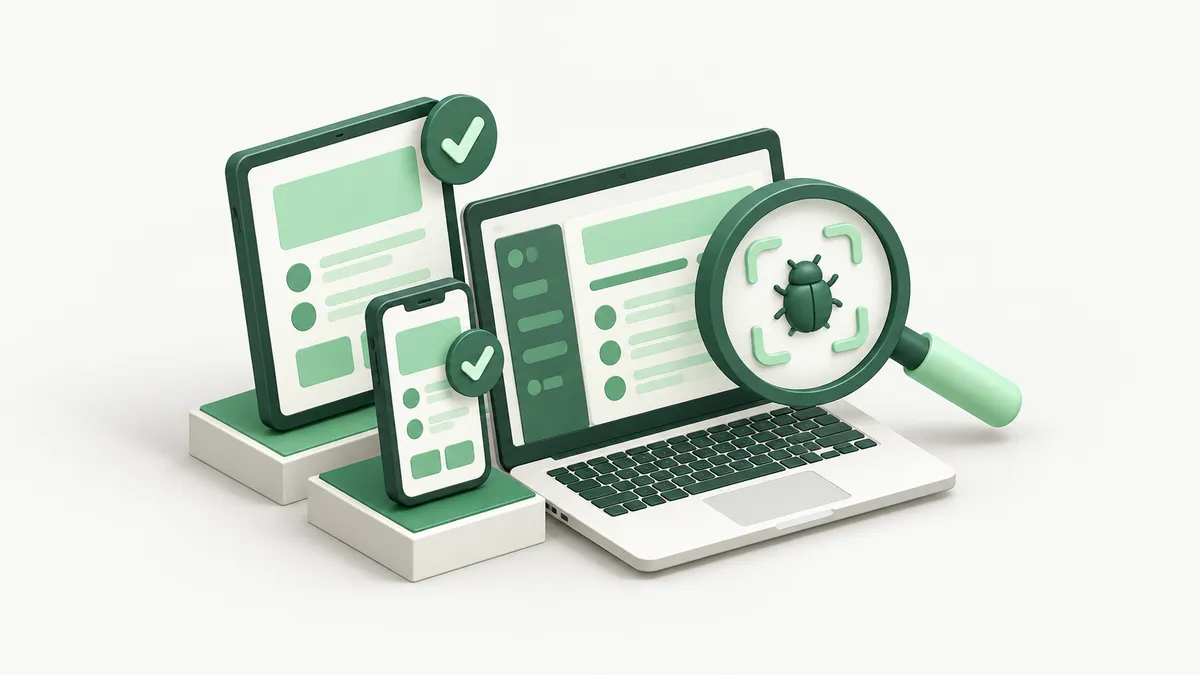
What you get
Test planning and manual functional QA
We begin with the product scope, requirements, designs, supported devices, and release risks. From that, we prepare a test plan and cases for sign-up, permissions, forms, payments, search, dashboards, notifications, error states, and the business paths that matter most. Exploratory testing covers the gaps scripted cases miss. Every issue includes the environment, exact steps, expected and actual results, severity, and supporting screenshots or recordings, followed by verification after the fix.
Automated regression coverage
Automation protects stable, repeated behavior. We add Jest unit tests around business rules and components, then end-to-end tests for critical journeys such as account creation, booking, checkout, and admin workflows. A focused regression suite runs before release and can join the delivery pipeline, while manual testing remains available for visual quality, new behavior, and unusual edge cases. We prioritize tests by risk instead of automating every screen for appearance's sake.
Real-device web and mobile testing
Browser emulators are useful, but they do not reproduce every keyboard, permission, network, safe-area, camera, or operating-system issue. We test responsive web products and React Native apps on real iOS and Android devices, across relevant screen sizes and browsers. Mobile release QA checks installation, upgrades, deep links, denied permissions, offline or weak-network behavior, background and foreground transitions, and the production build before App Store or Play Store submission.
Arabic, RTL, and bilingual QA
Arabic quality requires more than translating labels. We verify layout mirroring, navigation direction, directional icons, Arabic font rendering, joined letters, line height, long translations, and mixed Arabic and Latin text. Dates, phone numbers, prices, and codes are checked inside right-to-left screens so they remain readable. We also switch repeatedly between languages to catch stale content, misplaced alignment, and routes or metadata that show the wrong locale.
Performance and accessibility checks
We use Lighthouse and browser tools to review Core Web Vitals risks, oversized assets, blocking work, layout movement, and slow mobile loading. Accessibility checks cover WCAG basics such as color contrast, keyboard access, visible focus, heading order, form errors, alternative text, and screen-reader labels. Automated checks support the review but do not replace keyboard and screen-reader inspection. On our own enumgrow.com project pages, the same discipline achieves Lighthouse scores of 100 for accessibility and 100 for SEO.
Release QA and security basics
Before release, we test the production-like build, configuration, analytics, links, metadata, empty states, and rollback-critical journeys. For mobile stores, we check the signed build, permissions, privacy-facing copy, and the paths reviewers will use. Security checks cover common OWASP concerns at a practical level: input handling, authentication and authorization boundaries, exposed secrets, insecure storage, and unintended data access. Specialist penetration testing remains a separate engagement when deeper assurance is required.
Who it's for
Typical clients for this service, and the industries where we have already shipped it.
- SaaS & platforms
- E-commerce & booking
- Mobile apps
- Enterprise systems
- Arabic & bilingual products
How we work
- 01
Discovery
We learn your workflow, goals, and constraints, then send a clear scope and estimate within 24 hours.
- 02
Design
Wireframes and UI you can click through and approve before development starts.
- 03
Build in phases
Working releases every few weeks, with demos so you see progress and give feedback early.
- 04
Launch & support
Deployment, training, and a post-launch support period, with ongoing maintenance plans.
Frequently asked questions
Short answers to what clients ask us most. Anything else, ask us on WhatsApp and you get a reply the same day.
Can you test an app another team built?
Yes. We can join as an independent QA partner for an existing React, Next.js, React Native, iOS, or Android product. We first learn the release process and highest-risk journeys, then provide a prioritized report that your developers can reproduce without meetings to explain every issue. We can verify fixes and retain the regression suite for later releases.
What do we receive from a QA engagement?
Deliverables are agreed to fit the release, and can include a test plan, test cases, device and browser matrix, issue reports with evidence, regression results, Lighthouse findings, accessibility notes, and a release-readiness summary. Automated work also includes maintainable test code and instructions for running it. Findings are prioritized by user and business impact, not simply counted.
Do you test Arabic and English versions separately?
Yes. Each language is tested as a real product experience. Arabic QA covers RTL mirroring, fonts, wrapping, mixed-direction content, numbers, directional controls, and language switching, while both versions are checked for missing copy, inconsistent behavior, metadata, and routes. A screen passing in English does not automatically mean its Arabic version passes.
Can testing happen before every release?
Yes. We can define a repeatable release gate that combines automated regression with targeted manual testing on the changed areas and critical journeys. Web releases can include performance and accessibility checks, while mobile releases add real-device production-build testing before store submission. The scope can grow with the product as new risks and user paths appear.
Tell us about your project
Get a clear plan and itemized estimate within 24 hours — no obligation.